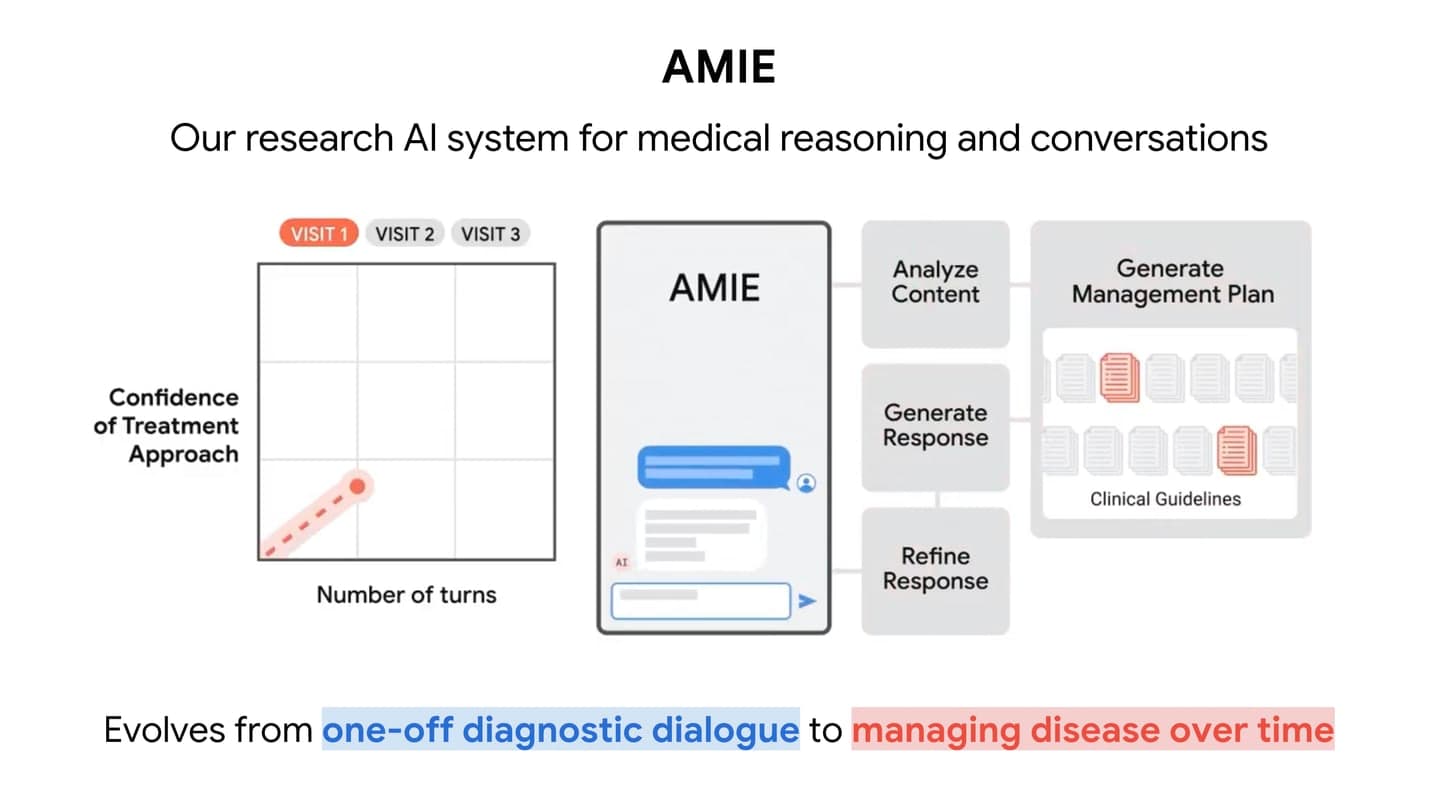
The medical community has long approached AI with a healthy dose of skepticism, primarily due to the "black box" nature of early diagnostic models. However, a significant pivot is underway. Recent clinical research published in the journal Nature reveals that AMIE (Articulate Medical Intelligence Explorer), a sophisticated conversational AI, has demonstrated the ability to match, and in some metrics outperform, board-certified primary care physicians in simulated diagnostic accuracy and bedside manner.
This isn’t merely a triumph of natural language processing (NLP); it is a structural evolution in how machine intelligence handles complex reasoning. Unlike traditional chatbots that rely on basic pattern matching, AMIE utilizes an architecture designed to manage the nuance of longitudinal health conditions, mirroring the iterative clinical workflow of a human specialist.
The Shift Toward Diagnostic Precision
The implications of this research extend far beyond the walls of a hospital. For business leaders in the healthcare and insurance sectors, the data confirms that AI agents are transitioning from administrative tools to active clinical decision-support systems. The study highlighted several critical capabilities:
- Multidimensional Data Synthesis: The AI successfully integrated disparate patient data points into a cohesive narrative, reducing the risk of "tunnel vision" diagnoses.
- Empathic Calibration: The model demonstrated an ability to communicate with high levels of empathy, a long-standing hurdle for automated systems.
- Diagnostic Efficiency: By narrowing down differential diagnoses faster than human counterparts without sacrificing accuracy, the potential for reduced operational costs is substantial.
For the modern enterprise, this represents a new frontier in Digital Transformation. By augmenting human experts with highly specialized agents, organizations can achieve a higher ROI on health-related workflows, from insurance claims processing to chronic condition management.
Strategic ROI and the Future of AI Integration
For executives, the integration of these high-reasoning models represents a fundamental shift in the Value Chain. We are moving away from simple automation—which handles repetitive tasks—toward complex AI Agents that assist in high-stakes human decision-making.
Adoption trends suggest that firms investing in specialized, industry-specific AI models today will see a significant competitive advantage over those relying on generic LLMs. The key to successful adoption lies in building systems that prioritize "human-in-the-loop" oversight, ensuring that AI-driven diagnostics are used to bolster the expertise of professionals rather than replace them. As we look at the trajectory of these tools, it is clear that the future of business operations will be defined by how effectively an organization can weave intelligent agents into its existing CRM and diagnostic infrastructure to optimize outcomes at scale.
Business leaders must now pivot their strategy from mere data collection to actionable intelligence. Integrating intelligent agents into your existing workflows requires a precise approach to architecture and security, which is where AOODAX specializes by developing custom AI agent solutions that streamline complex organizational decision-making. Whether you are looking to automate clinical workflows or enhance patient engagement through advanced chatbots, building an infrastructure that supports these high-reasoning models is the next logical step in your digital evolution.